
Anderson Criminal History Checks
Start an Anderson record check with the custodian that created the item. The city is the first stop for a police incident or arrest report and for municipal ordinance files. The county sheriff answers current booking questions, and the Circuit Clerk holds state criminal cases filed in McDonald County. Missouri Case.net adds a statewide public court index. The Missouri Automated Criminal History Site, or MACHS, is a separate repository product rather than a substitute for the city report or court judgment.
- Ask Anderson City Hall or Police for the city-created report, using the event date, location, report type, and any known number.
- Search the Anderson municipal division for ordinance or city traffic proceedings, then request the needed docket or disposition.
- Use Case.net to look for eligible public city and state cases, checking the court and case number before relying on a name match.
- Check the McDonald County jail roster for present custody and the Circuit Clerk for a county criminal file.
- Use MACHS when a Missouri repository history is needed, choosing fingerprints for a confirmed review of your own record.
The five channels answer different questions. A police report records the event as the agency first knew it. A municipal docket shows what happened to an Anderson ordinance charge. A county case may reflect a state prosecution. MACHS connects legally open reportable Missouri events, but a name result is only a possible match.
Anderson Police Daily-Log Records
Anderson’s city code provides a useful local distinction. If the Police Department keeps a daily log, the open fields include the time, substance, and location of the request for service; the response time and nature; and the occurrence time, date, and location. The log may also state basic circumstances, general injuries, property, or weapons. Those fields are more limited than a full investigative file, but they can help identify the right incident number or date range for a focused request.
The official City of Anderson portal is the source for city offices and municipal information. Its view of local government is shown below.
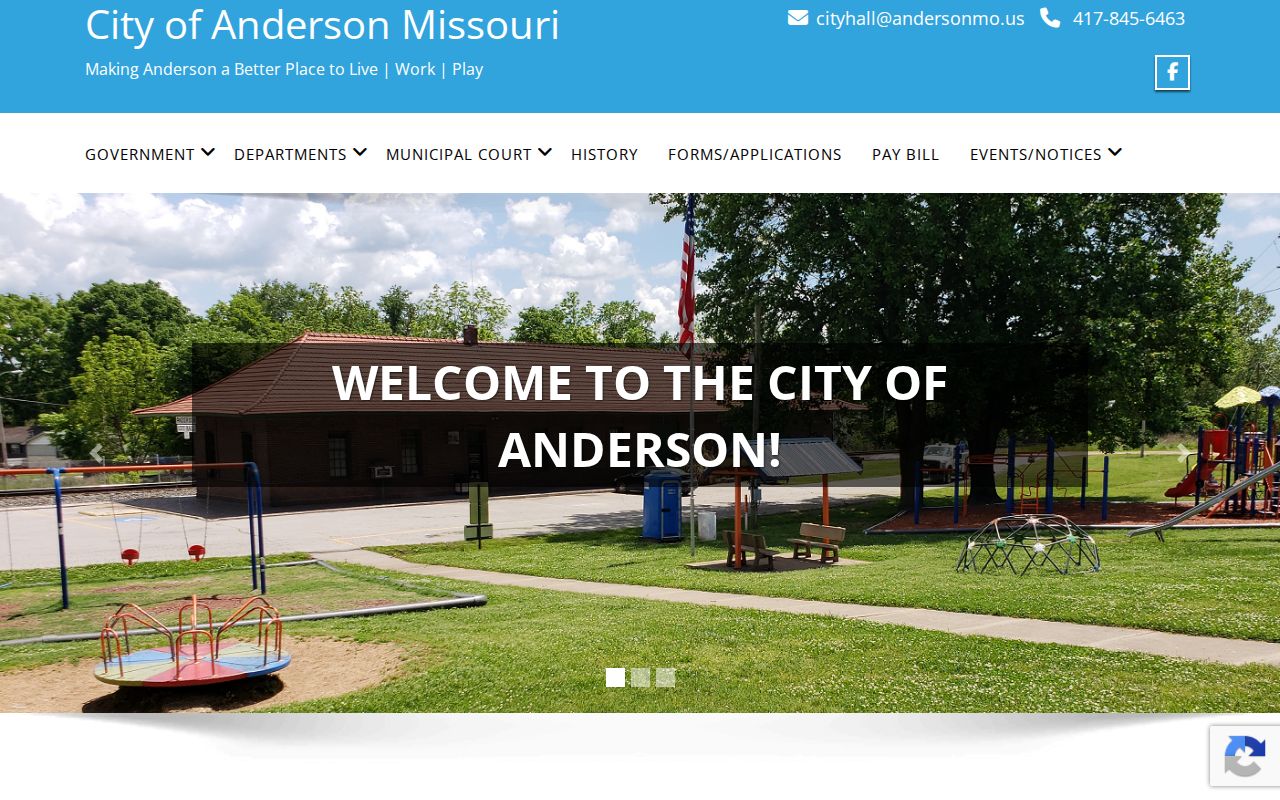
The city portal is a starting point, not an online police-log database. No dedicated Anderson records form, blotter, or self-service report portal was located, so the practical route remains a direct city request.
Records at the Anderson Police Department
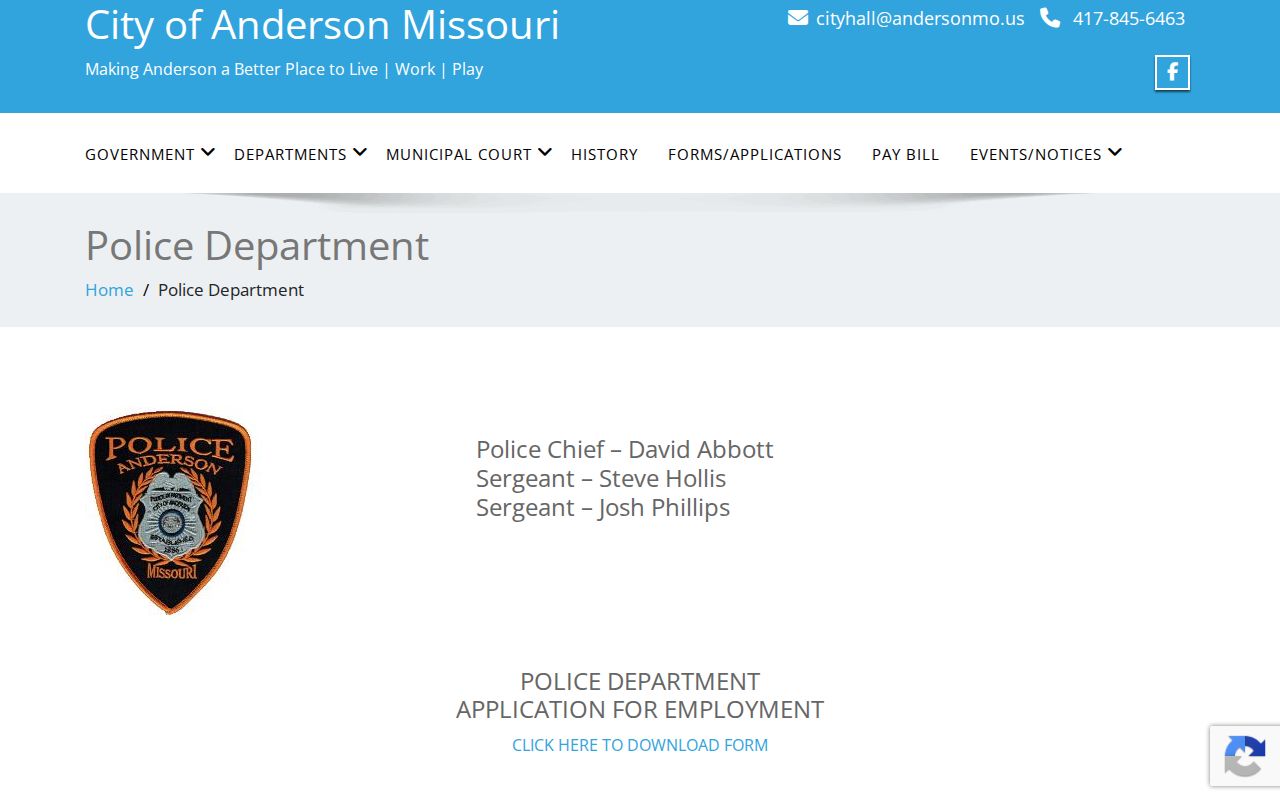
The Anderson Police Department works through City Hall at 103 W. Beaver Street, P.O. Box 397, Anderson, MO 64831. The published city line is 417-845-6463, and cityhall@andersonmo.us is the listed email. Chief David Abbott is identified on the official police page. No separate records-unit schedule or request portal is published, so call before visiting and ask which custodian should receive the request.
A clear request names the desired item, such as an incident report, arrest report, CAD entry, daily-log entry, photograph, or other public portion. Add the event date, place, involved agency, known report number, preferred electronic or paper format, and a fee limit. Ask for an estimate before chargeable work. The city may redact protected victim details, juvenile material, medical data, or active investigative content while releasing the open part.
The official department page pictured below confirms the local police channel and should be used instead of a commercial people-search service.
That direct route matters because an Anderson report is not automatically stored by the McDonald County Sheriff. The creating agency remains the first custodian even if a person is later booked at the county jail.
Anderson Arrest Records After 30 Days
Anderson Code section 120.120 tracks Missouri’s rule for an arrest that does not lead to a charge within 30 days. Basic arrest information can be open at first, then the arrest report closes after that period when no charge is filed, subject to statutory exceptions. That change can explain why an Anderson arrest detail seen soon after an event is not available in the same form later.
Closure does not mean every connected record vanishes. A dispatch log, basic incident facts, jail entry, or later court filing follows its own access rule and retention path. Ask the city for the releasable portion and state the precise record sought. Do not treat a closed public arrest report as proof that no event occurred or as proof that a person was cleared by a court.
Note: The 30-day rule concerns public access to an uncharged arrest report, not a finding about guilt or innocence.
Booking and Arrest Records in Anderson
An Anderson arrest can create several records. Police prepare the incident or arrest report. If the person enters county custody, the McDonald County Detention Center creates a booking entry. A prosecutor may later file a case, which produces a docket and disposition. The research found no documented Anderson city holding facility, so use the Anderson report first and the county jail check second without assuming every city arrest results in a Pineville booking.
The official sheriff roster answers a narrow question about current custody. It can show booking time, arresting agency, charges, bond, and status, but a booking charge may later change. If the name is absent, the person may have been released, transferred, never booked there, or not yet indexed. Call the Sheriff at 417-223-4319 for a recent status question. The broader McDonald County arrest search explains the county roster and report-request chain.
Anderson Case.net and Case Management
The official Anderson Municipal Court instructions describe two related Missouri court tools. Public Case.net searching lets a reader look by litigant name, filing date, case number, scheduled hearing, or judgment index. Manage My Case is an authenticated workflow for adding a ticket and handling eligible case tasks. It is not a different public criminal-history database. The court tells users to allow ten days before trying to add an Anderson ticket.
For a public search, confirm that the result belongs to the Anderson municipal division and not another Missouri court. Compare the case number, filing date, case type, and court location. If a ticket will not appear in the account after the stated wait, contact the Anderson Municipal Court rather than repeatedly broadening a name search. The official OSCA help line published by the city is 888-541-4894, weekdays from 7:30 a.m. to 5:00 p.m.
The Anderson Municipal Court File
The Anderson Municipal Court is a division of Missouri’s 40th Judicial Circuit and handles Anderson ordinance and assigned traffic matters. Judge Erin Willis and Court Clerk Erin Dornon are identified by the city. The clerk can be reached at court@andersonmo.us, and office hours are weekdays from 8:00 a.m. to 4:00 p.m. Posted court sessions are generally monthly at 3:00 p.m.
| Court | Anderson Municipal Court, 40th Judicial Circuit |
|---|---|
| Case Types | City ordinance violations and assigned municipal traffic matters |
| Public Search | Missouri Case.net, then the court clerk for documents or a certified disposition |
| Docket Contents | Case number, charge, events, hearings, plea, judgment, and payment status when public |
| Clerk Channel | court@andersonmo.us; weekdays, 8:00 a.m. to 4:00 p.m. |
A municipal file should not be confused with a Circuit Court felony or state misdemeanor case. If an Anderson incident leads to a state charge, search the county-level docket and request a certified outcome from the McDonald County Circuit Clerk.
Anderson Violations Bureau Records
A 2025 administrative order established Anderson’s Rule 37.49 violations bureau. For eligible matters, the clerk can accept an appearance, waiver, guilty plea, and payment in person, by mail, or electronically. Payment before the required appearance acts as a guilty plea and waiver of counsel and trial. That is a case action, not merely a fee transaction, and it can affect what the municipal docket later shows.
The city publishes both a fine schedule and a mandatory-appearance list. Check the charge against the current court material before assuming it is payable without court. A record reader should distinguish an amount listed on a schedule from the final judgment, costs, or later compliance entries in the actual Anderson case file.
How Anderson Records Reach the County
An Anderson officer creates the first police record. A municipal ordinance case stays with the Anderson division, while a state charge moves through the McDonald County Prosecuting Attorney and Circuit Clerk. A reportable fingerprinted arrest can then connect to later prosecutor, court, and correctional actions in the Missouri Central Repository through an Offense Cycle Number.
Record flow: Anderson Police › McDonald County Courts › Missouri State Highway Patrol Central Repository
Each stop captures a different stage. The city report describes the event and arrest basis. The county court file records the filed counts and result. MACHS supplies a legally filtered Missouri history. If the descriptions conflict, compare dates, count numbers, and dispositions instead of forcing the booking charge to match the final judgment.
Anderson Court Record Deadlines
The city’s rights page identifies several ten-day periods that can shape the docket. A request to change the judge follows the initial plea deadline stated by the court. A jury-transfer request must be made before trial within the published period, and an appeal follows judgment within its own ten-day window. These are procedural deadlines, not promises that a public online entry will update on the same day.
When reviewing an Anderson case, read the event dates in order. A plea, motion, judgment, and appeal notice can each change the posture. “Pending” means that no final disposition is recorded. If an entry is unclear or appears incomplete, use the case number when asking the municipal clerk for the public document that supports it.
Note: A Case.net event records a filing or court action; it does not by itself explain the full result or legal effect.
Anderson 911 and Incident Records
Anderson’s code separates a 911 recording from basic incident facts. The recording is generally restricted, while the date, time, specific location, and immediate facts can remain part of the open incident material. A request should therefore name both the item wanted and the fallback public fields. Asking only for “the 911 file” may miss the part the custodian can release.
Active investigative reports may remain closed until the matter becomes inactive, and protected victim information can be withheld. Requesting a redacted public portion gives the city room to release open facts without disclosing material the law protects. This approach also keeps the Anderson record request focused and easier to locate.
Anderson Record Access Rules
The Missouri Sunshine Law favors open public records while preserving specific exceptions. Anderson police and court custodians can withhold or redact juvenile data, protected victim information, medical details, security-sensitive material, and active investigative work. Court rules separately limit confidential cases, protected identifiers, and sealed or expunged records.
Ask for the open portion if the complete file cannot be released. The Anderson city code supplies local detail for police logs, incident facts, arrest reports, and 911 information, while Missouri law controls the broader access framework.
Key Statutes:
RSMo §610.011 directs public bodies to construe openness broadly and exceptions strictly.
RSMo §610.100 defines incident, arrest, and investigative reports and governs when each is open or closed.
RSMo §43.503 requires criminal-justice agencies to report qualifying actions to the Missouri Central Repository.
For a city copy, start with Anderson. For a county judgment, use the Circuit Clerk. For a Missouri repository product, use MACHS. That source-by-source method gives an Anderson record check a clear audit trail.